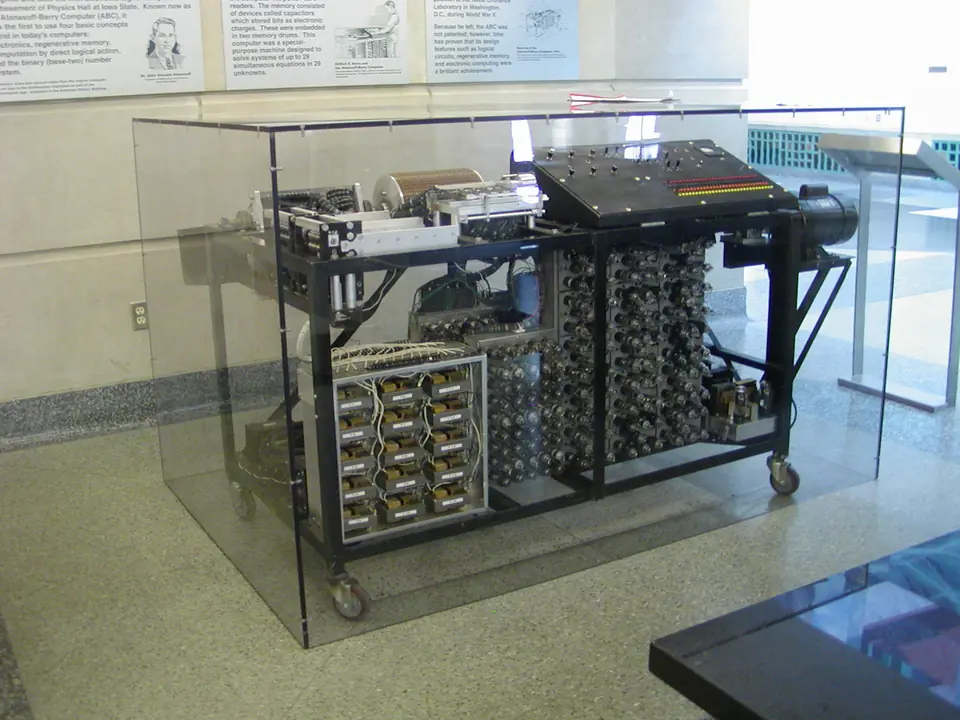
ABC was more than a faster calculating machine. Atanasoff changed how information was represented, processed and stored. These four principles formed the heart of his approach.
PRINCIPLE / 01
Electronics instead of mechanical wheels.
Mechanical calculators move physical parts. Atanasoff used electronic vacuum tubes to perform basic arithmetic operations, allowing electrical signals to replace many of the mechanical steps involved in calculation.
ABC still had moving parts, including its memory drums. The breakthrough was that arithmetic itself was performed electronically.
PRINCIPLE / 02
Zeros and ones instead of ten digits.
The decimal system uses digits from 0 to 9. Binary uses only two: 0 and 1. An electronic circuit can distinguish two states more reliably than ten precisely defined values.
The decimal number 13, for example, is 1101 in binary: 8 + 4 + 1. In the machine, numbers become sequences of states that electronic logic circuits can process.
PRINCIPLE / 03
Memory that remembers.
Atanasoff used capacitors to store binary states. Electrical charge can fade over time and therefore has to be restored periodically. He called this concept regenerative memory.
It was not an identical implementation of modern DRAM, but it anticipates an important principle: in certain memory systems, stored information must be refreshed.
PRINCIPLE / 04
Calculating through electronic logic.
Rather than modelling arithmetic as a sequence of mechanical motions, ABC used electronic logic circuits to add and subtract binary numbers. The operations were performed one bit at a time.
Its importance went beyond speed. The approach allowed hardware to be organised around simple, repeatable logical operations.